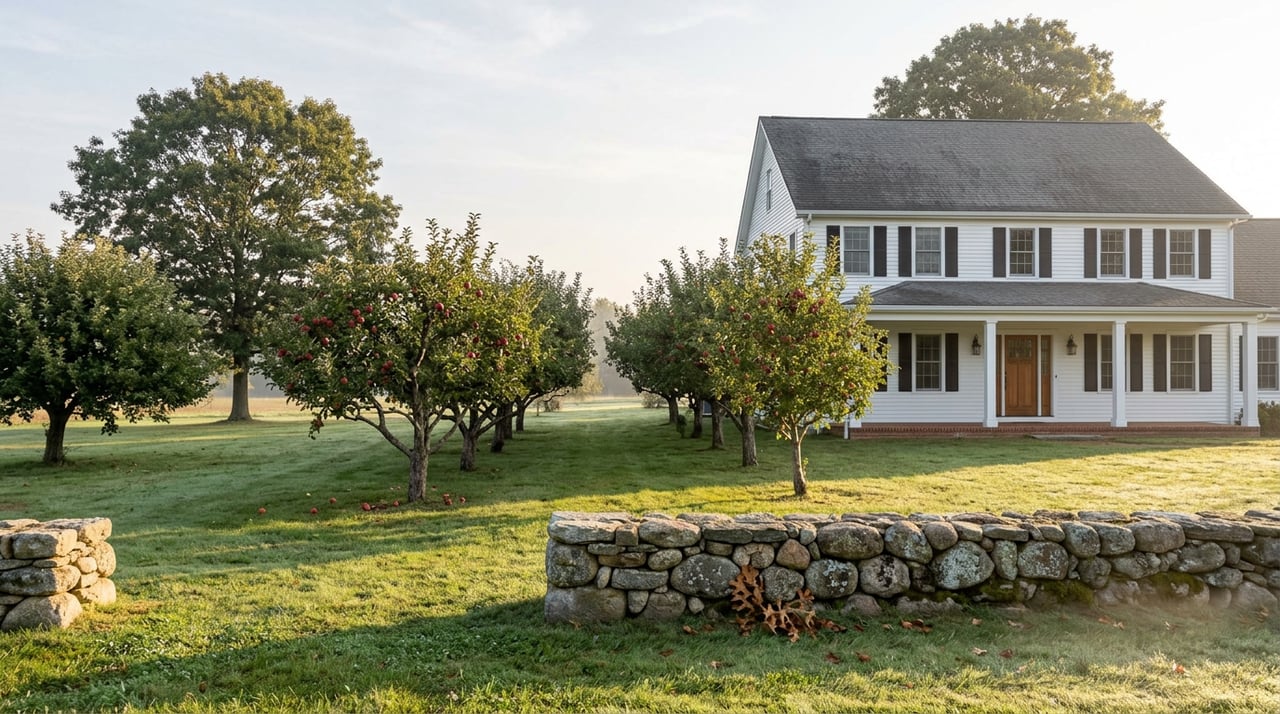
Walk a wooded lot in Harvard on a fall afternoon and it's easy to see why buyers fall for the acreage before they ever see a house. Stone walls run through the trees. A sightline opens toward Mount Wachusett. The listing sheet mentions well and septic design already underway, or a gently sloping field that used to grow something. What the listing sheet rarely spells out, at least not in plain language, is that a meaningful share of Harvard's open land carries a tax classification under Massachusetts General Law Chapter 61A, and that classification behaves nothing like the permanent conservation protection most buyers assume it is.
That confusion is the single most common surprise in a Harvard land transaction, and it's worth untangling before you write an offer.
Why So Much of Harvard's Land Carries This Status
Harvard's identity as a town is built on working orchards and farms, not as a marketing line but as a description of actual land use going back generations. Westward Orchards, now in its fourth generation of family ownership, and Doe Orchards both still operate working farm stands in town. A state heritage landscape inventory of Harvard cataloged specific working parcels under current-use classification, including a 63-acre active apple orchard enrolled in Chapter 61A and a horse farm where "most of the remaining land is in Chapter 61A." The same inventory traces the 18th-century Houghton-Hermann Farm on Oak Hill, still owned by descendants of the Hermann and Carlson families.
None of that is incidental to how land moves through the market here. Chapter 61, 61A, and 61B let a landowner get their property assessed at its current-use value, forestry, agriculture, or recreation, rather than its full development value, in exchange for keeping the land in that use. It is a voluntary program, renewed annually with the local assessors, and it is exactly the kind of arrangement that shows up quietly in a title search or an assessor's card on a Harvard lot that looks, to a buyer touring it in October, like nothing more than a pretty field.
What Actually Happens When Enrolled Land Changes Hands
A sale by itself doesn't trigger anything. What matters is what the land is used for afterward. Three separate mechanisms can apply, and they don't all fire at once:
- Right of first refusal. If a sale involves converting the land to residential, commercial, or industrial use, the town has the right to buy at the same price and terms as the pending offer, generally within a 120-day window, before a private sale can close.
- Conveyance tax. Under Chapter 61 and 61A, this starts at 10 percent of the sale price if the land is sold or converted within its first year of enrollment and drops by roughly one percentage point per year until it disappears after ten years. Chapter 61B land carries 10 percent for years zero through five and 5 percent for years six through ten.
- Rollback tax. This is the difference between what the owner actually paid under the current-use classification and what they would have paid at full assessed value, plus 5 percent simple interest per year, calculated for up to five years of enrollment.
If a buyer keeps the land in a qualifying use, none of these get triggered by the purchase itself. That single fact is where most of the confusion starts, because it means the tax exposure is entirely a function of what happens next, not who signs the deed.
The Distinction That Trips People Up
Chapter 61A is a tax status. It is filed annually, it can lapse if a landowner simply forgets to renew, and it can be withdrawn without penalty as long as the land stays in a qualifying use for five years afterward. An Agricultural Preservation Restriction, or APR, is a different animal entirely. It's a recorded legal restriction on the deed itself, and once it's in place, it runs with the land permanently, through every future owner, regardless of what any of them intend to do with it.
Harvard has a real example of that exact transition. Community Harvest Project's orchard on Prospect Hill sat on land gifted to the nonprofit in 2014, farmed for years while the acreage benefited from current-use tax treatment. It wasn't until 2022 that 70 of the orchard's 75 acres were permanently protected through an APR, in a deal that involved the Town of Harvard, the Harvard Conservation Trust, Sudbury Valley Trustees, the U.S. Natural Resources Conservation Service, and the Massachusetts Department of Agricultural Resources. The Harvard Conservation Trust holds a separate easement for a trail along the orchard's edge.
Before that 2022 deal closed, the orchard's protection was tax status, not permanent restriction. As CHP's executive director Tori Buerschaper put it, describing the years before the APR was finalized, the nonprofit "could have made the decision to sell it to the highest bidder." That's not a hypothetical about some other town's farmland. That's Prospect Hill, in Harvard, sitting one signature away from a very different outcome for most of a decade.
Here's the distinction laid out side by side:
| Chapter 61A | Agricultural Preservation Restriction | |
|---|---|---|
| What it is | Annual tax classification | Permanent recorded restriction |
| Renewal | Required every year with assessors | None needed, it doesn't expire |
| Can it lapse | Yes, if not renewed or use changes | No |
| Runs with future owners | Only as long as they keep filing | Yes, permanently |
| What a sale triggers | Possible rollback or conveyance tax, town right of first refusal | Nothing, the restriction is already in place |
What This Means If You're Making an Offer
If you're looking at acreage in Harvard, ask early whether any part of the parcel is enrolled under Chapter 61, 61A, or 61B, and ask for the current CL-1 filing or forest management plan if it applies. That paperwork tells you whether the enrollment is current, when it was last renewed, and how many years of look-back exposure exist on the rollback calculation.
If your plan is to keep farming, keep the woodlot managed, or otherwise continue the qualifying use, you're generally not walking into a tax bill just by closing. The law even carves out an exception for building one house on Chapter 61 land as a family member's primary residence, which doesn't disqualify the rest of the parcel, though that house and its curtilage get assessed separately going forward.
If your plan involves subdividing or building beyond that carve-out, budget for the possibility of a rollback or conveyance tax, and build in time for the town's 120-day window if the change of use could trigger the right of first refusal. That's not a formality to skip past. It's baked into the statute, and a seller's attorney should be flagging it well before the purchase and sale agreement gets signed.
Three Questions Worth Asking Before You Sign
Does buying enrolled land automatically cost me money? No. The tax exposure follows a change in use, not the transfer of ownership. Continuing the same qualifying use generally avoids both the rollback and conveyance tax.
Is Chapter 61A the same as land trust protection? No. It's a revocable tax arrangement the owner files annually. A conservation restriction or an APR, like the one now permanently protecting most of Prospect Hill, is a different legal instrument recorded on the deed itself.
Can the town stop my purchase? Not directly. What the town can do, if the land use is changing, is match the offer within its statutory window. If the use isn't changing, that right typically doesn't come into play.
Harvard's land carries more history than most listing sheets let on, and that history has real terms attached to it. If you're weighing a piece of acreage here, or you own land that's been enrolled for years and are wondering what a sale actually looks like, The Naroian Group can walk through the specifics with you. Book a local market consult before you write the offer, not after.